
Moves Management: How to Cultivate Donor Relationships
Cultivating donors for your nonprofit—especially those who may make major gifts—is an involved process. At any given time, your organization might have multiple individuals at different stages of the donor journey, each of whom has a different giving capacity and level of interest in your mission. How do you keep track of all of these relationships so you can approach each current and prospective donor in a way that resonates with them?
The answer is to implement a moves management system at your organization. In this guide, we’ll cover everything you need to know about moves management, including:
Let’s get started by discussing what moves management is and why it matters for nonprofits like yours.
Moves Management: Frequently Asked Questions
What is moves management?
Moves management (also known as moves management fundraising) is a strategic approach to building relationships with your nonprofit’s current and prospective donors. It involves assessing each individual’s position in their journey with your organization and determining the best next steps (or “moves”) to push them toward their next phase of support.
While your nonprofit will likely create a standardized moves management system for efficiency, it’s critical to tailor the exact moves you plan to each supporter to develop a long-term relationship with them. Personalization shows donors that your organization sees them as integral community members, not just as ATMs with legs. Additionally, your moves management processes should be adaptable as donors’ needs change.
How does moves management relate to the donor management lifecycle?
The donor management lifecycle (also called the donor lifecycle or donor journey) is a visualization of the stages of support that an individual goes through as they’re converted from an unengaged prospect into a loyal contributor to your nonprofit. Moves management is the strategy by which your organization makes this conversion happen, since the objective of each move or combination of moves you plan should be for a supporter to progress from one phase to the next.
Here is a quick breakdown of the six steps of the donor management lifecycle:
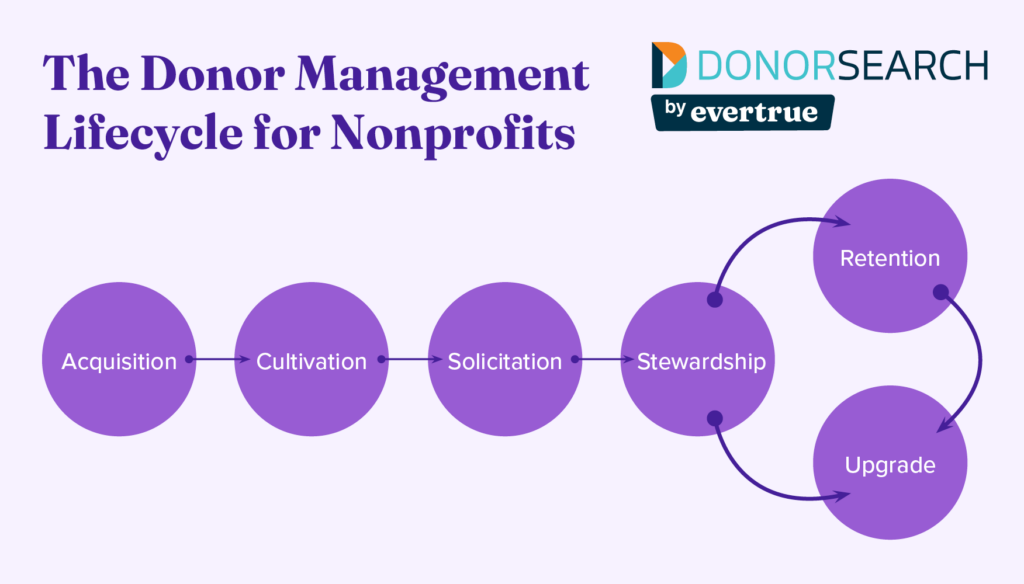
- Acquisition. This stage involves identifying potential new donors for your nonprofit and making initial contact with them. Lower-level supporters will usually contact you by responding to one of your organization’s mass marketing messages (for example, they might fill out the contact form on your website or scan a QR code on a flyer). When acquiring major donors, your nonprofit will individually reach out to individuals you’ve identified through prospect research.
- Cultivation. Once your nonprofit has established contact with a donor, the next step is to start building a relationship with them. As you get to know their interests, values, and motivations for supporting your organization, start thinking about how to offer opportunities to contribute that will resonate with them.
- Solicitation. The more money you plan to ask a donor for, the longer it’ll take to get them to the point where you’re ready to ask them for a donation. With lower-level supporters, you can often solicit a donation right away, while you might need to make several smaller engagement asks before requesting a major gift.
- Stewardship. Once a donor has responded to your fundraising solicitation, you should promptly express your gratitude for their gift. The size of your thank-you should match the size of each donor’s contribution—a personalized email is usually sufficient for small donations, while major gifts warrant larger-scale recognition, like an annual report mention or an invitation to a donor appreciation event.
- Retention. After your initial thank-you, plan strategic follow-ups and additional individualized outreach to encourage first-time donors to stay involved with your organization. Although acquiring new donors helps your organization grow, retention is more cost-effective and establishes a reliable support system for your nonprofit.
- Upgrade. When you know a supporter is committed to your mission long-term, you can start suggesting ways to boost their engagement and lifetime value. For instance, you could ask a sporadic low-level donor to join your recurring giving program or try to convert a mid-level supporter with a high giving capacity into a major donor.
Note that the stewardship, retention, and upgrade stages are cyclical. Once a donor upgrades their support, you should promptly thank them for their latest contribution and plan a series of moves to keep them engaged with the eventual goal of another upgrade.
Why is moves management fundraising useful for nonprofits?
Incorporating moves management into your fundraising strategy can allow your nonprofit to experience multiple benefits, including:
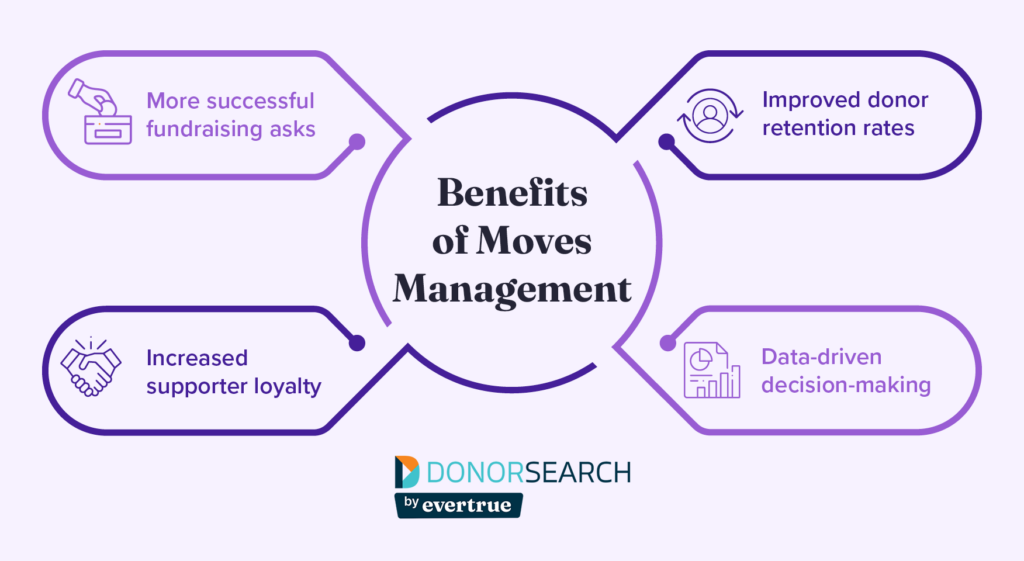
- More successful fundraising asks. Moves management helps your nonprofit understand donors’ ability and willingness to give and tailor donation requests to each individual’s preferences. Supporters will be more likely to say yes to your solicitations if they fall within their desired giving range and if they can support an aspect of your work that aligns with their values.
- Improved donor retention rates. Taking a strategic approach to donor relationship-building can help your organization meet or exceed sector benchmarks for retention. According to the 2026 Nonprofit Benchmark Report by Virtuous, the overall gross donor retention rate is 54.73%, with small organizations typically having rates below 40% and very large nonprofits often exceeding 60%. Meeting the target for your nonprofit’s size helps build a stable support base for your mission.
- Increased supporter loyalty. If donors feel like your organization truly cares about them and offers appealing opportunities to support your mission, they’ll be excited to stay engaged in many different ways. They might even spread the word about your nonprofit to their friends and family and convince them to get involved as well!
- Data-driven decision-making. For your moves management system to be effective, you should record each move you make with a donor and their response. Then, by analyzing this information, you can draw conclusions about what moves tend to work best with your current supporters to inform your basic strategy for cultivating future donors who share similar characteristics.
When you acquire a supporter, create a new profile for them in your constituent relationship management (CRM) system. Include a section at the top of each profile to track recent and upcoming moves for that donor, which makes it convenient for your team to review and evaluate this information in a centralized location.
Steps of the Moves Management Process
To help your nonprofit get started with moves management, we’ve broken the process down into the following five steps. Use the flip cards below to get a quick overview of each step, or read on for a more detailed explanation.
1. Identify Your Target Audience
Before you can start moving donors through the donor management lifecycle, you first have to determine who would fit the bill for the type of donor you want to acquire. Consider the following factors when choosing a target audience:
- What size gifts you need (small, mid-level, major)
- What fundraising initiative you want the donor to contribute to (GivingTuesday, annual fund, capital campaign, etc.)
- What resources you have to help with acquisition (team member time, communication platforms, screening tools, etc.)
- Whether you’re looking to engage a specific demographic (such as people living in a certain area or an age group your nonprofit would like to see better represented in its supporter base)
Having a general idea of these factors allows you to start narrowing down your target audience. If you want to cast a wide net for smaller donations, your target audience might be something like, “Millennials who are passionate about our mission, live within 25 miles of our headquarters, and could give at least $10.” To effectively solicit major gifts, you’ll need to conduct research to narrow your list even further to the names of your top prospects.
2. Set SMART Goals
Once you know your target audience, develop a preliminary idea of the results you’d like to see from your nonprofit’s moves with them. As with any initiative or process your organization undertakes, the best moves management goals follow the SMART model, meaning they are:
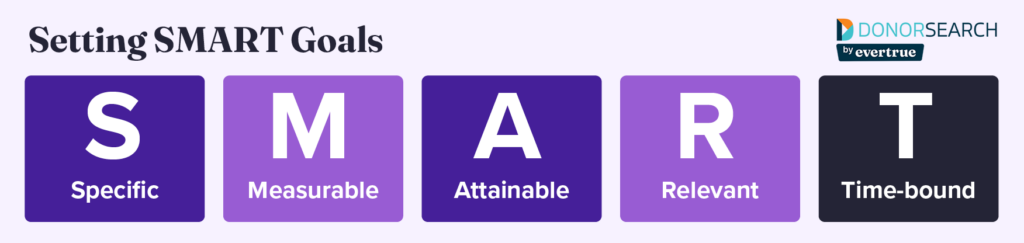
- Specific
- Measurable
- Attainable
- Relevant
- Time-bound
Since adaptability is important for effective moves management, don’t be surprised if you need to adjust your goal as you start moving a donor through the lifecycle.
Let’s say that based on prospect research, you set a SMART goal “to ask [prospect name] for a major gift of at least $10,000 for our upcoming capital campaign within the next six months.” However, if the prospect is slow to respond to your communications, expresses interest in supporting a different project, or has a change in their financial situation, it’s in your best interest to modify your goal accordingly.
Once a donor is in the stewardship-retention-upgrade phase of their journey, you can use their past history with your nonprofit to set new SMART goals for keeping them engaged.
3. Get to Know Your Donors
After you’ve set your first SMART goal, it’s time to move potential donors into the acquisition and cultivation phases of the donor lifecycle. Similar to audience identification, the larger the gifts you’re looking for, the more individualized your outreach and relationship-building should be. While small personal touches like adding donors’ names to email subject lines can show low-level supporters that your nonprofit values them, you’ll mostly use segmented mass marketing tactics to reach these audiences.
For major donor prospects, contact them individually to set up one-on-one meetings with a major gifts team member. During this meeting, the team member should get to know the prospect’s:
- Personal and family background
- Professional history and connections
- Interests, hobbies, and values
- Favorite charitable causes they’ve previously supported or activities they’ve participated in
Afterward, the team member should record the information they learn in the donor’s profile. That way, the rest of your team can reference it when deciding on next moves and eventually putting together the main fundraising ask for that donor.
Additionally, it’s useful to bring up these details in future conversations with the prospect. For example, if a donor mentioned that they had a vacation planned to celebrate their upcoming wedding anniversary, asking them how the trip was and wishing them a happy anniversary the next time you talk to them shows that you’ve made an effort to get to know them personally.
4. Choose Your Moves for Each Donor
Use what you’ve learned about each prospect to plan the moves you’ll use to get them to make the contribution you decided on in your adjusted SMART goal. Remember that for major donors in particular, you might need to make several smaller asks to get them involved in your nonprofit’s work before you’re ready to make your main solicitation. For instance, you could:
- Send regular follow-up messages via their preferred communication method to update them on current initiatives
- Invite them to participate in fundraising events or volunteer opportunities that align with their interests
- Ask them to consult on a project or join a committee that could benefit from their professional expertise
- Introduce them to other members of your staff and board who share mutual connections with them or work on campaigns they might want to support
There is no set number of moves or time frame for issuing your main fundraising solicitation. Everything depends on how the prospect responds to each move, which is why adaptability is essential for effective moves management.
5. Track Data and Make Adjustments
Record every move you make with a prospect and their reaction in their donor profiles. This way, your whole team will know:
- Everything you’ve already done to engage a prospect
- What didn’t work so you can avoid repeating those moves
- What they responded well to so you can build on that success
This data can also serve as a loose framework for engaging future prospects with similar backgrounds, giving capacities, and affinities for your mission. However, it’s critical to remember that what works for one donor may not work for another and vice versa, even if the two individuals look similar on paper.

Essential Tools for Moves Management
To develop a successful moves management system, it’s important to leverage the right software. Make sure your nonprofit has these tools in its tech stack before starting the process:
- A donor database or nonprofit CRM that supports robust donor profiles and user-friendly moves tracking
- Communication and stewardship tools for personalized outreach and efficient follow-ups
- A prospect research database to lay the foundation for targeted acquisition, cultivation, and solicitation
- Data analytics and modeling solutions—tools powered by artificial intelligence (AI) provide the most thorough insights
If you’re looking for a solution that combines multiple essential tools to take your moves management to the next level, look no further than DonorSearch by EverTrue! More than 15,000 nonprofits of all shapes and sizes trust DonorSearch’s comprehensive prospect research solution for accurate information on their donors, and our cutting-edge AI provides enhanced insights into that data to help you prioritize your outreach.
DonorSearch also integrates with over 40 CRMs and fundraising tools, so you can seamlessly transfer prospect research data to donor profiles. And, as part of the EverTrue family, our tools allow your nonprofit to tap into a full ecosystem of fundraising technology to streamline donor engagement. But don’t just take our word for it—check out this video to learn how the Lambda Chi Alpha Educational Foundation used DonorSearch to analyze over 100,000 alumni database records and uncover more than $33 billion in untapped giving potential:
Final Thoughts
An effective moves management system will help you design donor journeys that deepen prospects’ emotional connection to your mission, which will inspire them to support your nonprofit in impactful ways. More than that, you’ll know what to do to repeat your successes and retain their support long-term.
For more information on moves management and the tools required to do it well, check out these resources:
- 18 Best Prospect Research Tools to Find High-Impact Donors. Discover a variety of prospect research solutions you can use to kick off the moves management process.
- Nonprofit Donor Databases: Everything You Need to Know. Explore our recommendations for donor database platforms where you can store your moves management data.
- AI Fundraising: How to Build Your Nonprofit’s Strategy. Learn more about the emerging role of artificial intelligence in many nonprofit fundraising processes, including moves management.